The founder who is the sales team
Every deal needs you in the room. You know the product better than anyone and you close when you get the meeting, but there is no process, no playbook and no way to hand it to someone else.
Sales strategy and go-to-market for women founders of B2B tech companies in Europe, CEE and the Gulf. You have product-market fit, deals close when you are in the room, and the numbers are not repeatable yet. I built go-to-market (GTM) for US tech companies, LinkedIn, Oracle and Pluralsight, and led sales teams across 65+ countries. Now I build it with founders. It starts with 30 minutes and your pipeline.
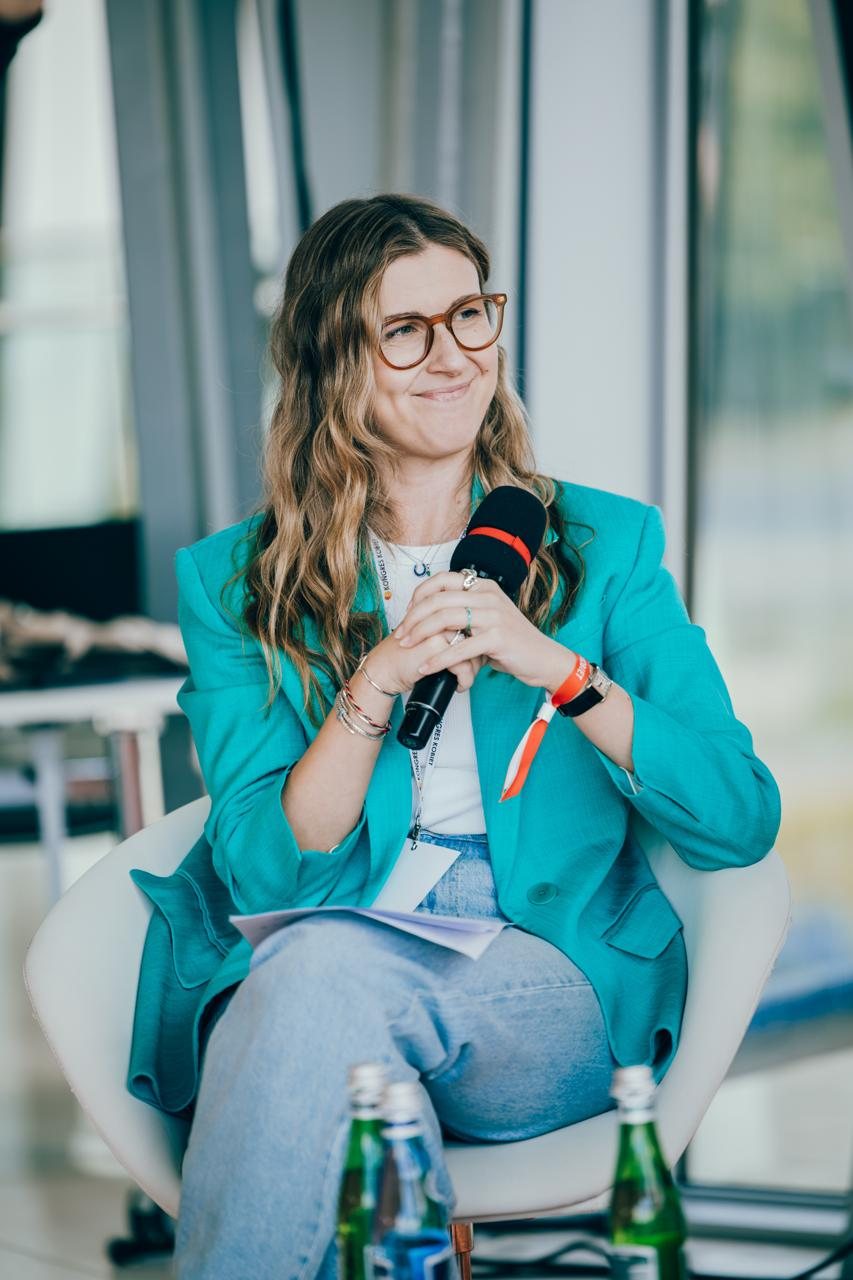
Speaking at Kongres Kobiet, Kraków.
Three versions of the same situation. If one of them is yours, the call is worth your 30 minutes.
Every deal needs you in the room. You know the product better than anyone and you close when you get the meeting, but there is no process, no playbook and no way to hand it to someone else.
Investors want a forecast you can defend and a motion you can scale. Right now the forecast is a guess and the motion is you, your inbox and whoever replied this week.
One or two reps, inconsistent results, no shared definition of a good deal. You are not sure whether the problem is the people, the targeting or the fact that nobody wrote down how you sell.
Technical, product and domain-expert founders are the usual profile. Selling into enterprise and government, across borders, is where I have spent most of my career.
The product is fine. The problem is upstream of the pitch. The founder sells to anyone who will listen, so the pipeline fills with logos that look great and take a year to decide. There is no definition of who to walk away from. The forecast is built from hope, so the board stops trusting it. And because nothing is written down, every new hire sells differently from the last one.
None of that is a confidence problem, and I will not treat it as one. It is a system problem, and systems can be built. I did it inside US tech companies for 12 years, for markets from Warsaw to Dubai, and the method is the same at a 20-person startup: Diagnose. Design. Deploy.
Bring your pipeline. I will tell you what is broken and what I would fix first. You leave with something to do next week, whether or not we work together.
Your last ten deals (won and lost), whatever you use as a pipeline, and how you currently forecast. Ten minutes of your time, no slides.
Where deals stall, who you should stop selling to, and the one change that would move the number first. Blunt, specific, from experience.
Either a short note with what I would do if it were my company, or, if it fits, the GTM Execution Program: six months, remote, built with you.
I work with 8 to 10 clients at a time, directly. No junior consultants, no deck that lives in a drawer.
We were in classic founder-led sales - winging every call, celebrating the deals luck sent our way, and quietly wondering how any of this would survive contact with a new market. I didn't need a cheerleader. I needed someone who could look at the mess and tell me exactly what to do on Monday morning. …I stopped guessing and started operating.
Walery MarcinowiczFounder, Hishoo · GTM Execution Program client
We worked on three areas that made a tangible difference: reshaping my LinkedIn narrative to sharpen how our company is positioned in the market, segmenting our B2B audience so we could focus on the buyers who actually move fast, and building a practical approach to enterprise sales pipeline development. …Alicja has a sharp understanding of how decisions really get made inside large corporations.
Bartosz NarzelskiVenture Partner & CPO at FFvLab, building FinPath Mentoring engagement
Full case study: from founder-led sales to an operating system, in the founder's own words.
Because the questions keep coming, and because I have spent a career making sure women in commercial roles get the sponsor they need.
For 12 years I worked for US tech companies, LinkedIn, Oracle and Pluralsight, running sales teams in Europe and the Middle East and reporting into American leadership. As a leader I promoted many women from individual contributor into leadership, inside and outside my own organisation, and acted as a sponsor for women. I am a member of Polish Businesswoman Network and Women in Tech UAE, and I work actively with Women Empowered in Wroclaw.
In those rooms the same questions come up from founders every time: who do I sell to first, how do I forecast something I have never done before, when do I hire, which country next. This page is the direct answer. The programme behind it is open to any B2B tech founder; the door is here because this is where I keep being asked.
Thirty minutes, over video, from Dubai or wherever you are. If I am not the right person, I will tell you who is.
Pracuję po polsku i po angielsku. I work in Polish and English.